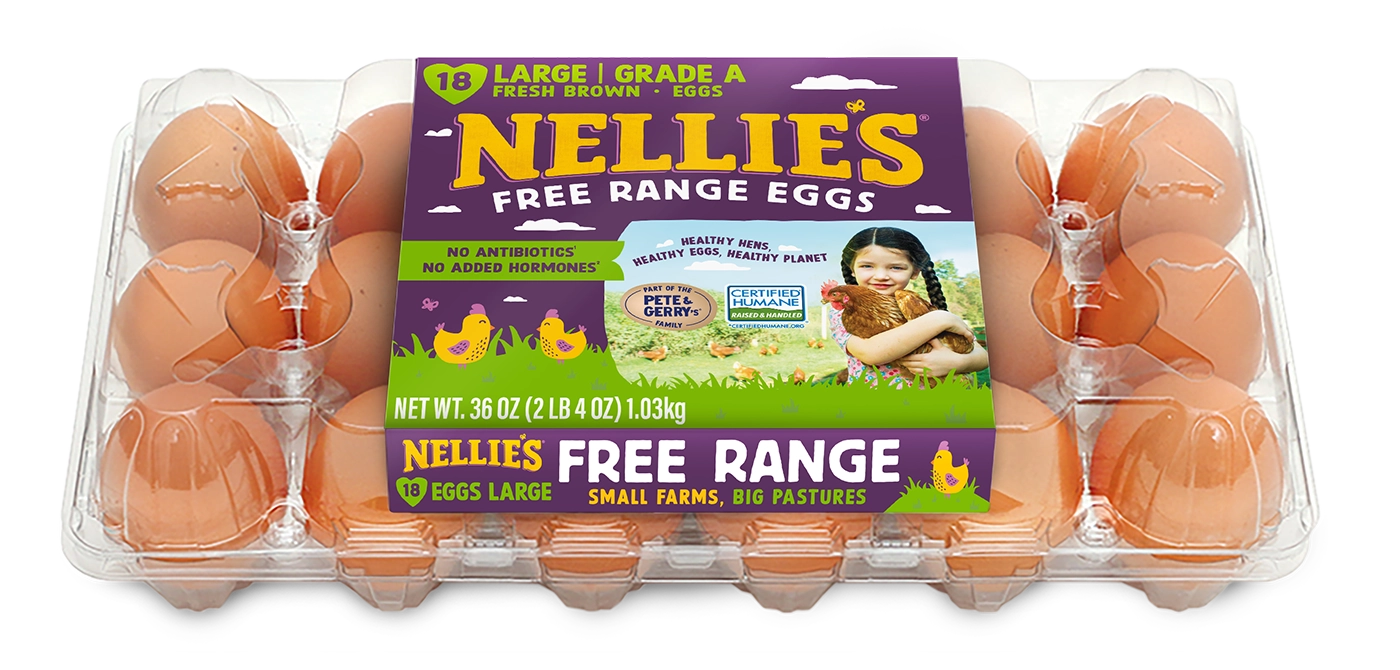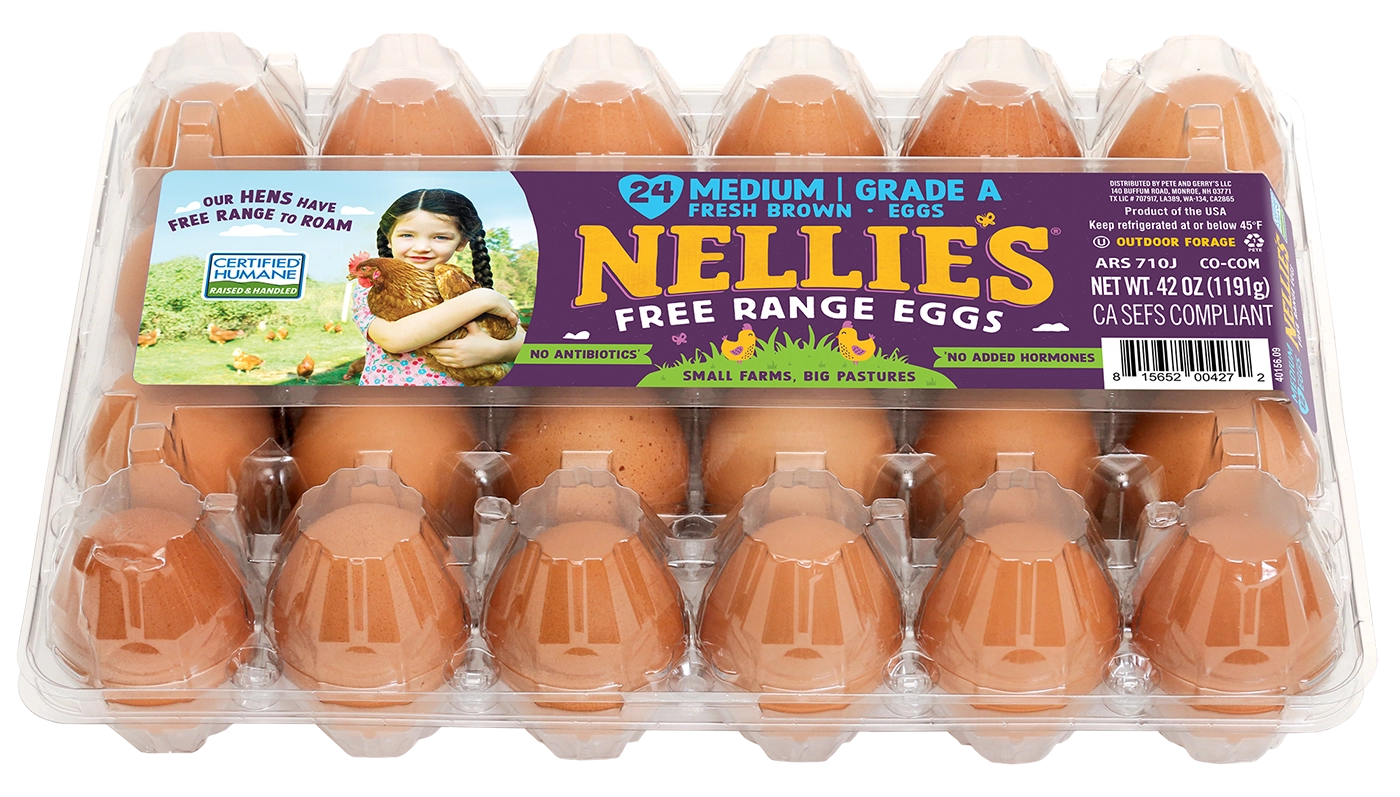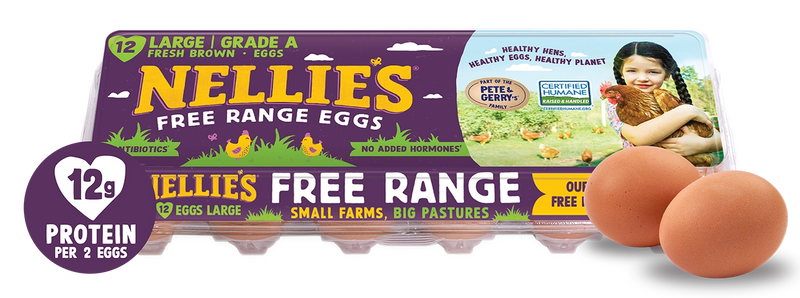
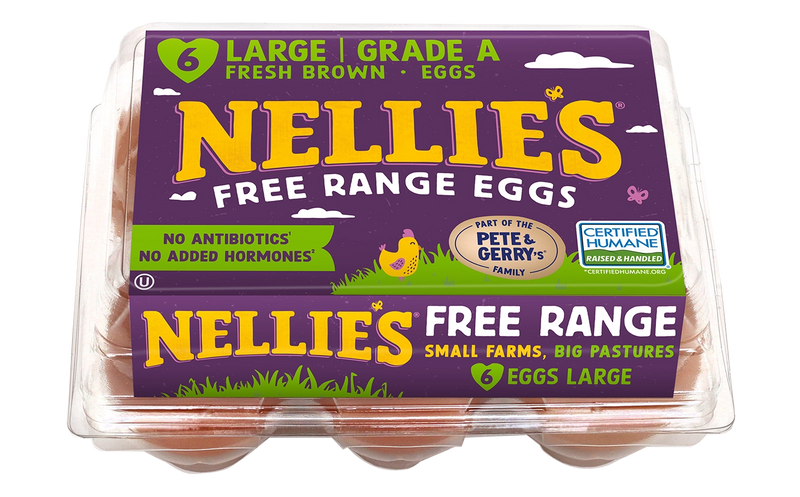
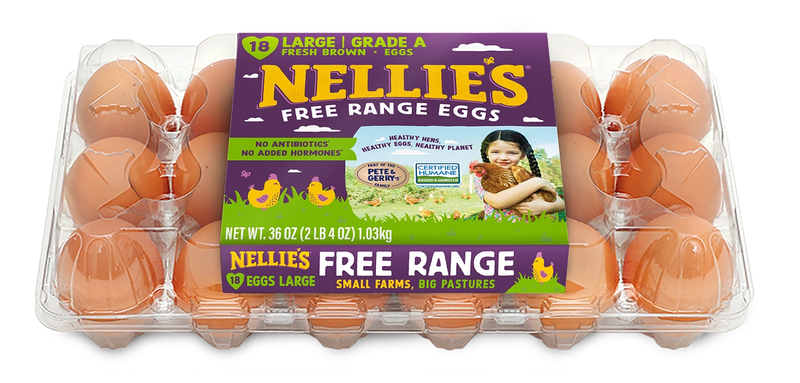
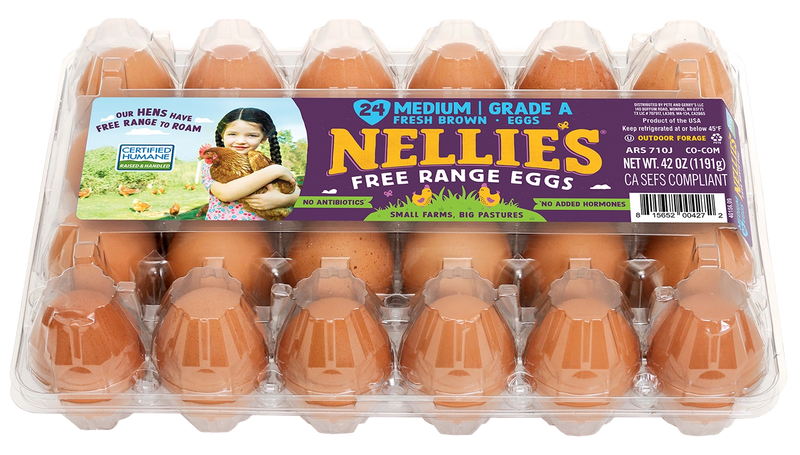
Free Range Eggs

It would come as no surprise if our hens laid heart-shaped eggs; that’s how much kindness and care goes into each and every purple carton. So what does all Nellie’s fun, foraging, and gabbing with her gals mean for you? Better, yummier eggs that taste like pure love no matter how you prepare them.

Available sizes: M, L, XL, Jumbo

Quantity

Find In Stores

  • 6g

    Protein

  • 70

    Omega 3

  • 70

    Calories

  • 0g

    Carbs

5 Reasons to Eat Eggs Daily

Nutrition Facts

Serving Size:

1 Large Egg (50g)

Calories 70
Total Fat 5g
Saturated Fat 1.5g
Trans Fat 0
Cholesterol 185mg
Sodium 70mg
Total Carb. 0g
Dietary Fiber 0g
Total Sugars 0g
Protein 6g
Decorative illustration

Why Nellie's?

No antibiotics or hormones

No antibiotics or hormones

No one wants “gunk” in their eggs, and that includes Nellie! Our hens are never treated with antibiotics or given hormones. Thanks to their airy, uncrowded, clean, and safe living conditions, preventive measures often found on caged and cage-free factory farms have no place on Nellie's Free-Range farms—or in your food.

A healthy, sustainable protein

A healthy, sustainable protein

Did you know that eggs are nature’s perfect protein? The 6 grams of protein found in a Nellie’s Free-Range Egg are made up of all nine essential amino acids that are vital to our health, making them a complete source of protein. Eggs are considered nutrient-dense; for good reason, they're packed with 12 other essential vitamins and nutrients for a mere 70 calories. On top of all that, eggs are an incredibly affordable and earth-friendly vegetarian source of protein that everyone can enjoy.

Raised on family farms with big pastures

Raised on family farms with big pastures

Unlike cage-free hens, Nellie and her free-range friends have access to green, grassy pastures where they can do what they do best: just be hens. Working with independent family farms ensures our flocks receive the hands-on, round-the-clock care they deserve. But don’t worry; big pastures give our gals plenty of alone time to cluck about the latest farm gossip without an audience.

B Corporation Certified

B Corporation Certified

As part of the Pete & Gerry's family of brands, Nellie's Free Range became the first egg producer in the country to achieve Certified B Corporation status in 2013, solidifying our dedication to using business as a force for good through our balanced commitment to people, planet, and profit in all that we do—and of course, taking a cue from our hen friends by leading with kindness and curiosity at every turn.

Test Your Eggspertise

Are hens omnivores or herbivores?

Omnivores! Free-range hens enjoy a diverse diet of greens and pasture grubs.

Decorative illustration

FAQs

Should I eat eggs past the best before date?

The best course of action for determining whether your eggs are safe to eat is to check the best by date, along with a few pieces of information that can help determine their freshness. Once a carton has passed its best by date, or 45 days from being processed, those eggs are considered expired and we’re unable to guarantee any safety or results from consuming them.

According to the U.S. Dept. of Agriculture (USDA): “Many eggs reach stores only a few days after the hen lays them. Egg cartons with the USDA grade shield on them must display the “pack date” (the day that the eggs were washed, graded, and placed in the carton). The number is a three-digit code that represents the consecutive day of the year (the “Julian Date”) starting with January 1 as 001 and ending with December 31 as 365. When a “sell-by” date appears on a carton bearing the USDA grade shield, the code date may not exceed 45 days from the date of pack.”

For a full explanation of the details on our eggs' best before date and tips for telling whether your eggs are still good, check out our blog

Do you wash the eggs? Does that impact their quality?

Due to FDA regulations and food safety requirements, we must wash our eggs before consumers can receive them. We use a light, organic approved soap to wash our egg shells. After the eggs are washed, they are sanitized with a mild chlorine solution. Our Quality Assurance team monitors critical control points like wash- and rinse-water temperature, detergent levels, etc. This does remove the cuticle (or bloom) from the egg, which is a natural protective coating that typically remains on unwashed eggs, but we must wash them per FDA requirements. 

How does nutrition impact yolk color?

Natural fluctuations in yolk color can happen for a variety of reasons: flock age, changes in weather, time of year, and even flock location. The bugs that our hens peck at also can play a part in the yolk color as an unpredictable increase of protein in their diet. Each flock and individual hen is unique, which tends to be reflected in their eggs.

We routinely check our free range and pasture-raised eggs for yolk color and find they are typically much darker than caged, factory farmed eggs. We're committed to offering our hens a more natural and varied diet, but sometimes these humane practices can lead to lighter yolks from time to time. 

What causes blood spots in an egg?

Blood spots are caused by the rupture of a blood vessel on the yolk surface when it’s being formed. Typically, the presence of blood spots is an indication of a very fresh egg. As an egg ages, the blood spot diffuses across the white and becomes almost undetectable over time.

Blood spots can occur in up to 6% of all brown shelled eggs. From time-to-time, the incidence of blood spots in eggs increases above the normal, 6% rate, when the hens in a flock get excited by changes in lighting, changes in temperature, or when they catch a cold. Candling methods reveal most eggs with blood spots and those eggs are removed, but even with electronic spotters, (as we have) it is impossible to remove them all. We also carefully inspect the eggs with cameras that check the interior when we package them but due to shell density, color, contrast and depth, some of these eggs do get through. Sometimes, if the spot is small, it can be cut out with the tip of a knife and the egg is still perfectly fine to eat.

What causes double yolks?

Double yolks are fairly rare (about 1/1000) and double-yolked eggs tend to be very, very large. These eggs are typically are graded as 'Super Jumbo' due to their size. Double yolks primarily come from younger flocks whose bodies are just learning how to lay eggs. All of our farm fresh eggs are run through the sorting machine together, and any eggs identified as Super Jumbos are sent to the first packing station to be packed by hand because they're too big for the machine.

The hand packing station fills Jumbo cartons with Super Jumbos all day long, placing each carton in the same case, which explains why rare double-yolked eggs often end up in the same carton. All of these larger eggs are packaged together as Jumbos (even though they are technically Super Jumbos), and over 50% tend to have double yolks. 

Why do some eggs float in water?

Any egg that floats in water is likely very old and should not be eaten. Every egg contains an air cell that occurs naturally and expands as the egg ages. Once enough oxygen has had time to permeate the shell, the air cell can grow large enough to keep the egg afloat in water. We suggest tossing any eggs that float in water, or learning more about the water test for checking egg freshness on our blog here.

Are your liquid egg whites pasteurized?

Our 16 ounce containers of liquid egg whites are pasteurized and are great for most baking applications. Want to find locations where our egg whites are sold? Check here.

Can I use your liquid egg whites to make meringue desserts?

Because of the effects of the pasteurization process on the protein structure, our liquid egg whites will not whip to soft or stiff peaks and are not recommended for any meringue-style recipes. This includes meringue cookies, meringue toppings, meringue-based frostings, and whipped egg white components in recipes such as fluffy Belgian waffles.

When you whip fresh egg whites, air bubbles generated by the whipping action are held in suspension by protein structures created within the egg white, producing a fluffy and light meringue that will also hold stiff peaks. The pasteurization process changes the structure of those proteins, so they can no longer work together to hold onto the air bubbles. As a result, when you whip the pasteurized egg whites, you will be able to froth and foam them to a degree, but they will continue to stay fairly runny (even with extended whipping).

These foamy, pasteurized whites do work great for mixed drinks and cocktails as they are safe to consume raw, but for making those classic, crunchy clouds of meringue or silky whipped topping, we recommend good old-fashioned fresh egg whites for the best result.

How do I measure your liquid egg whites?

To substitute for 1 large egg white, use 2 tablespoons of our liquid egg whites. To substitute for 1 large whole egg, use 3 tablespoons of our liquid egg whites. 

How many eggs does a hen lay per day?

It's right around 1 egg per day for most hen breeds. A typical flock will average around 307 eggs per hen over the first 52 weeks of laying, which will slow down a bit as the hens age.

What causes different egg shell colors?

Egg shell color is determined by the breed of hen and is often related to the color of the feathers over the hen’s earlobes. Brown hens, like those on our farms, typically lay brown eggs and white chickens lay white eggs (although there are a few breeds of white chickens with brown ear-feathers that lay brown eggs). However, it's important to note that shell color has nothing to do with the nutritional content or quality of an egg.